[2026/10] The technical report of Intern Lumina U2 is now on arXiv. I am a core contributor and led the whole training process on 1024 Ascend 910B NPUs.
Zongyang (Zane) Qiu|邱宗扬
I'm Zongyang Qiu, an MPhil student at HKUST(GZ), advised by Prof. Hui Xiong, and co-advised by Prof. Zeyu Wang. Previously, I received my B.S. degree in Computer Science from Fudan University.
Currently, I am a student researcher at Shanghai Innovation Institute (SII), supervised by Yutao Sun, working on world models, specifically, training VLMs with a strong spatial awareness and the potential for embodied applications. I am also working closely with Yijiang Li and Prof. Nuno Vasconcelos at UCSD in the field of video reasoning. Previously, I was a research intern at InternLM Group, Shanghai AI Lab, supervised by Dr. Bin Fu, focusing on building the next-generation Unified Models. Before that, I worked with Dr. Zeyu Wang at CIS Lab, HKUST(GZ), and with Prof. Wenhan Luo at C4 Group, HKUST.
I am deeply passionate about extensive topics in Computer Vision and Computer Graphics. I aim to explore the construction of biological-like visual intelligence, which should be capable of autonomous understanding, decision-making, and generation within both physical and digital worlds. My current research focuses on multimodal learning of VLMs and reasoning ability in visual generative models. I am trying to practice Slow Science.
News
[2026/09] Joined Shanghai Innovation Institute as a Student Researcher.
[2026/04] Honored to be named a Shanghai Outstanding Graduate (Top 5%).
[2026/02] Joined the Statistical Visual Computing Laboratory (SVCL) at UCSD as a Research Assistant.
[2026/01] Joined Shanghai AI Laboratory as a Research Intern.
[2026/01] Delighted to attend AAAI 2026 in Singapore and give an oral presentation.
Publications
* Equal contribution (co-first authors)Papers where I am the first or co-first author
Intern Lumina U2: A Multi-Codebook Diffusion Large Language Model for Omni-Visual Understanding and Image Generation
arXiv /Project Page /Code /
arXiv preprint
@misc{yu2026internlumina,
title={Intern Lumina U2: A Multi-Codebook Diffusion Large Language Model for Omni-Visual Understanding and Image Generation},
author={Yu, Qian and Qiu, Zongyang and Yan, Juncheng and Li, Hongliang and Qin, Qi and Wang, Keqi and Luo, Siqi and Ju, Junkui and Mi, Yapeng and Lu, Tiantian and Liu, Tian and Xie, Pengyu and Ji, Chenhao and Zhang, Minghui and Zhao, Yiang and Yan, Siyu and Xu, Haiying and Wang, Yanbo and Shen, Jianghan and Pu, Yuandong and Lei, Jiayi and Zhang, Borui and Shi, Jinxin and Zhang, Bo and Zang, Yuhang and Ye, Shenglong and Gu, Lixin and Zhang, Hongjie and Liu, Linghan and Chen, Xinyuan and Cao, Yuewen and Zhang, Lihe and Liu, Xiaohong and He, Junjun and Liu, Qiangwei and Zhang, Qi and Cheng, Yu and Xue, Tianfan and Xiong, Hui and Xu, Chang and Qiao, Yu and Liu, Yihao and Fu, Bin},
year={2026},
eprint={2610.20818},
archivePrefix={arXiv},
primaryClass={cs.CV},
url={https://arxiv.org/abs/2610.20818}
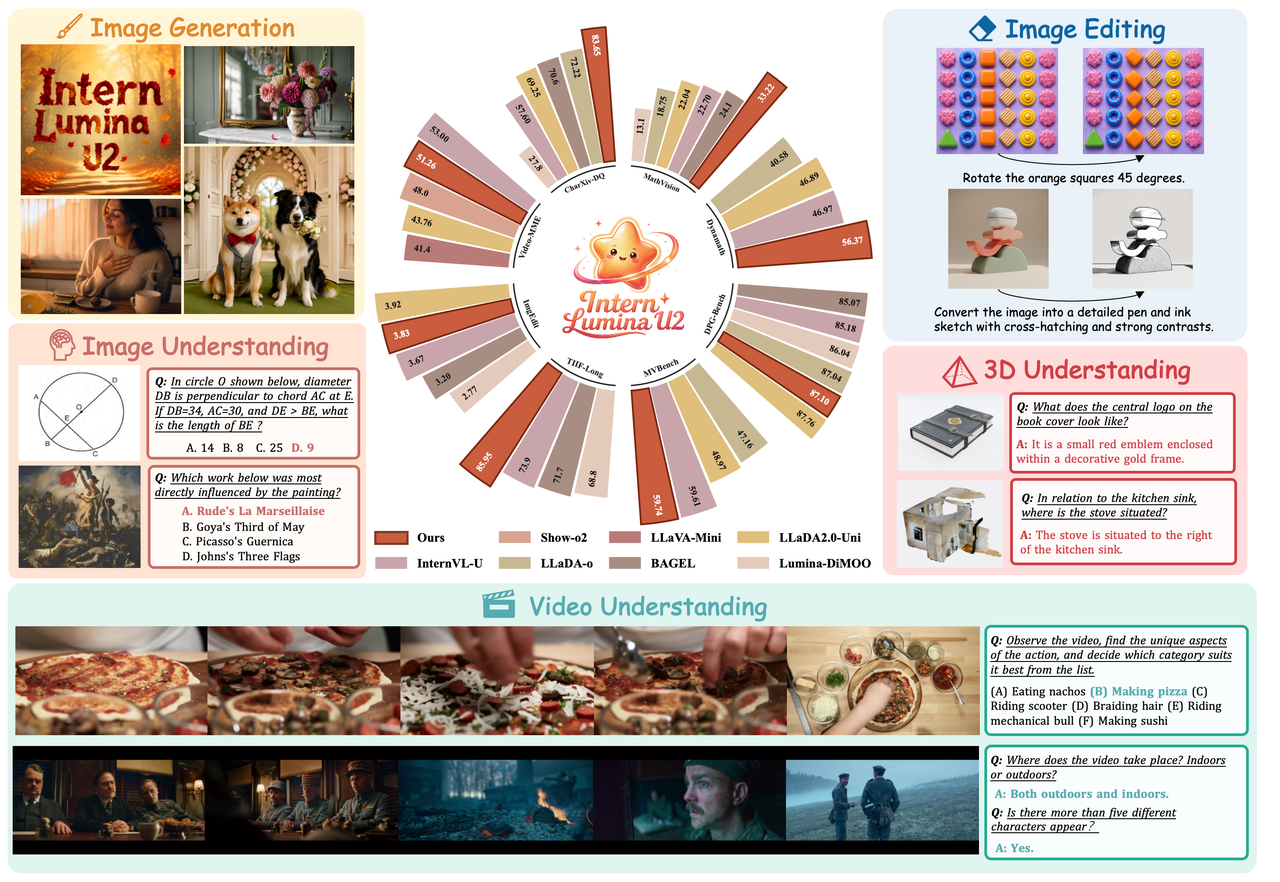
}Unified multimodal generation covers discrete, continuous, and hybrid paradigms. Discrete approaches with single-codebook visual tokenizers align naturally with text modeling but have limited representational capacity. Continuous and hybrid approaches retain richer visual representations, but they model text and images in heterogeneous spaces with different training objectives, potentially introducing optimization conflicts between modalities with misaligned representation spaces. These choices expose a central question: how to efficiently model high-capacity visual representations alongside textual content in a shared optimization space within a single backbone. We present Intern Lumina U2, to our knowledge the first diffusion language model to represent multi-codebook visual tokens in a fully discrete space. Each visual position is represented by a group of codes from complementary codebooks, increasing its representational capacity while preserving compatibility with discrete text modeling. At the input, the embeddings are concatenated at each position; at the output, a lightweight multi-codebook autoregressive head predicts the codes within each position sequentially, while the diffusion backbone processes all positions in parallel. Built on the unified 4D representation of AToken, Intern Lumina U2 supports image, video, and 3D inputs within a single backbone and achieves leading performance among unified models in visual understanding, image generation, and image editing. We further build a full-stack training, inference, and evaluation system on both Ascend and NVIDIA platforms to verify the cross-platform effectiveness of our model. We also improve the inference efficiency through a stability-aware sampling strategy, which combines confidence-plateau-guided unmasking approach with drift-triggered cache refreshing mechanisms, accelerating image generation by 4.45×.
RoboAware: Learning to Coordinate Embodied Skills from Counterfactual Outcomes
arXiv /
arXiv preprint
@misc{zhou2026roboaware,
title={RoboAware: Learning to Coordinate Embodied Skills from Counterfactual Outcomes},
author={Zhou, Bohan and Chen, Xingbei and Huang, Emily and Ruan, Weilin and Huang, Haojian and Zhang, Yehang and Li, Zexi and Li, Wenqian and Yu, Qize and Song, Zetian and Wu, Leyi and Li, Jinghao and Song, Mingxuan and Xu, Xinrun and Qiu, Zongyang and Wei, Yangkai and Zhang, Tianyi and Zhou, Kaiwen and Li, Yinchuan and Cheng, James},
year={2026},
eprint={2610.11480},
archivePrefix={arXiv},
primaryClass={cs.RO},
url={https://arxiv.org/abs/2610.11480}
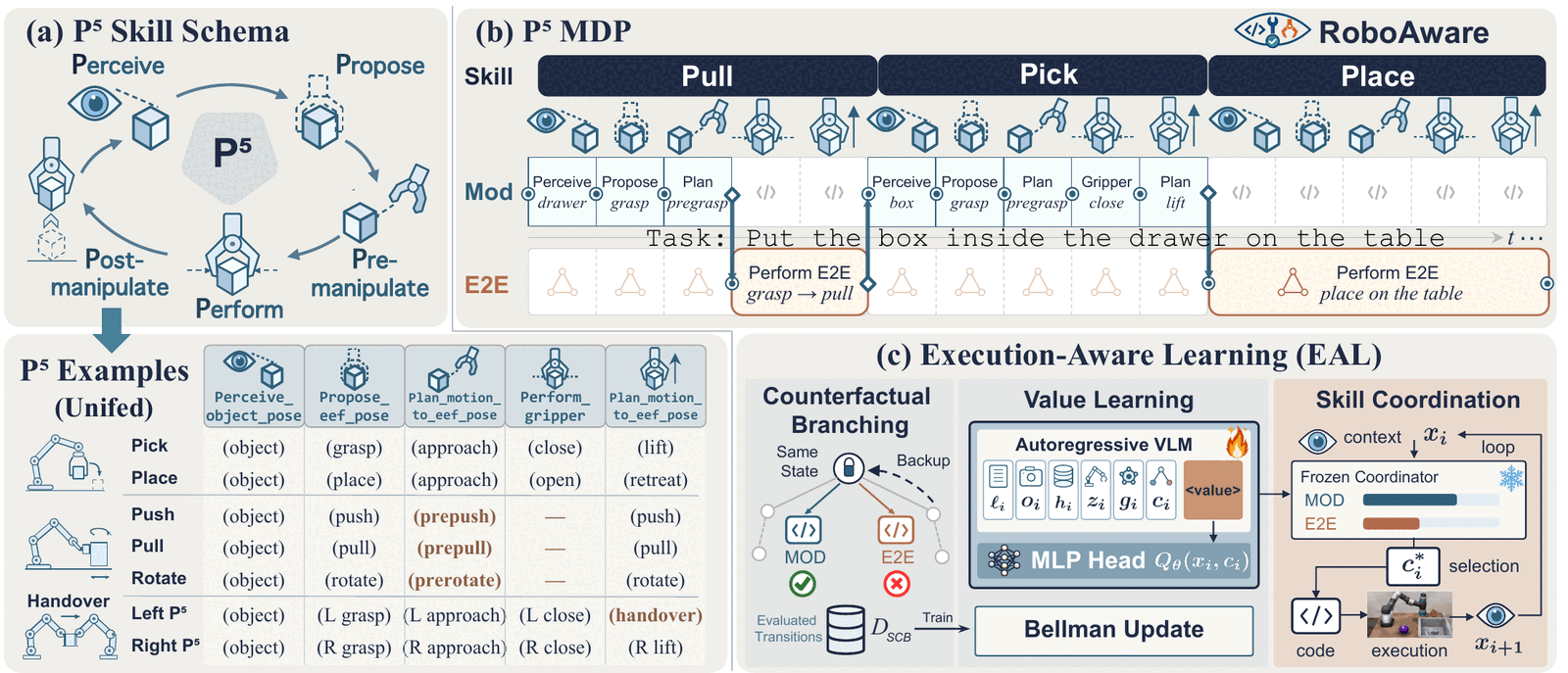
}Embodied coding agents can combine modular robot skills with frozen end-to-end policies, yet effective composition requires anticipating which policy family will succeed in the current physical state. We present RoboAware, which builds on coding agents’ skill orchestration by learning only a state-conditioned responsibility coordinator from counterfactual outcomes. Inspired by the success of REPL, we propose the P5 schema and formulate a hierarchical MDP based on it. P5 organizes skills uniformly into five semantic stages, defining where responsibility can be compared. To address the lack of counterfactual branch outcomes in existing work, we introduce State-Locked Counterfactual Branching (SCB), which restores the same training state to generate and execute a code block from each admissible family, exposing outcomes that selected-branch experience leaves unobserved. Building on this, we propose Execution-Aware Learning (EAL), which combines Monte Carlo tree search with Q-learning to distill these outcomes into family-conditioned values. At deployment, the coordinator selects the policy family according to observable context, and the frozen coding agent generates the next local code block. Comprehensive single-episode evaluations on 100 tasks show that RoboAware reaches a 77.0% overall success rate, with SOTA averages of 90.0% on RoboSuite, 73.8% on diverse LIBERO-Pro task clusters, and 90.0% on challenging RoboTwin bimanual tasks, outperforming existing code-as-policy and VLA-harness baselines.
Where a New Concept Must Enter: Entry Point Gates Cross-Task Usability in Unified Multimodal Models
arXiv preprint
@misc{qiu2026entrypoint,
title={Where a New Concept Must Enter: Entry Point Gates Cross-Task Usability in Unified Multimodal Models},
author={Qiu, Zongyang and Wu, Yihan and Fan, Kaixuan and Li, Bo and Xiong, Hui},
year={2026},
eprint={2608.17564},
archivePrefix={arXiv},
primaryClass={cs.CV},
url={https://arxiv.org/abs/2608.17564}
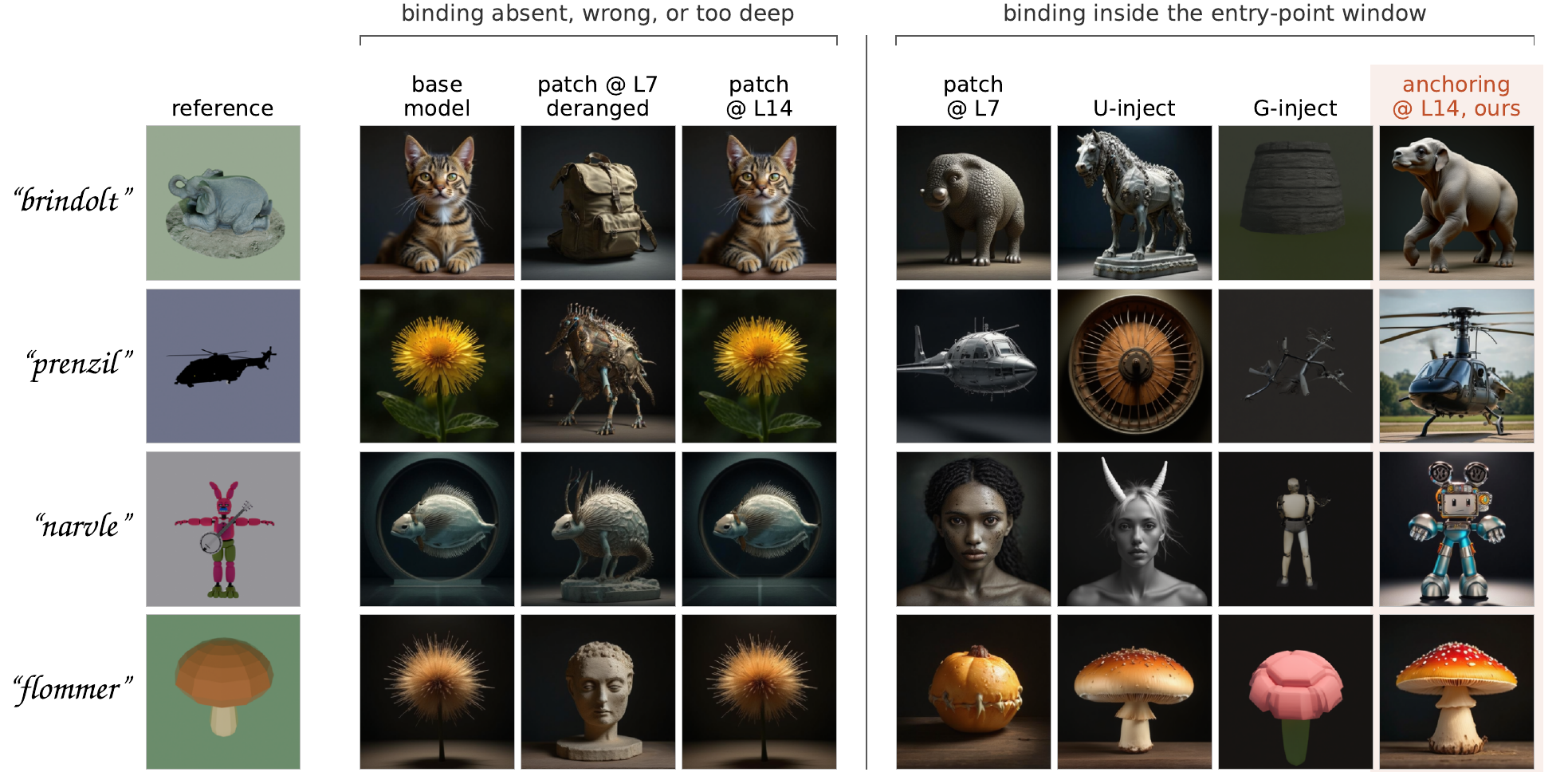
}Unified multimodal models (UMMs) are motivated by the hope that understanding and generation reinforce each other but controlled ablations repeatedly find that adding a generation objective leaves understanding flat. Joint-training studies cannot settle the disagreement: with overlapping supervision, a gain cannot be attributed to the architecture rather than the data. To further investigate the relationship between the two directions in UMMs, we separate them by construction. A novel visual entity, a rendered 3D asset paired with a pseudo-word screened for absence from the frozen model’s behavior, is bound through exactly one task direction, and the untrained direction is then measured. We find that the channel is real in both directions, but the directions differ in kind: generation training installs a name the model can only match among candidates; understanding training installs one it can also produce. What governs cross-task usability is where the binding enters the shared computation. An alignment probe predicts export across 36 configurations (Spearman ρ = +0.68). That objective’s alignment term, maximized in closed form over activations with every weight frozen, makes a concept drawable when injected at layer 7 of 28 and is indistinguishable from the base model from layer 14 on, while the weight-based version of the same edit peaks at layers 10-14. In an observational series of four models, this window appears only where the understanding pathway is a semantic vision encoder, suggesting that unified weights are not enough: the two directions must share a semantic format at the entry point. Exploiting the rule, a mid-stack alignment objective acquires the concept for a 0.1% relative loss of the model’s general text-to-image ability, against 41% for the standard generative route.
EmoSpace: Fine-Grained Emotion Prototype Learning for Immersive Affective Content Generation
arXiv /
arXiv preprint
@misc{wang2026emospacefinegrainedemotionprototype,
title={EmoSpace: Fine-Grained Emotion Prototype Learning for Immersive Affective Content Generation},
author={Bingyuan Wang and Xingbei Chen and Zongyang Qiu and Linping Yuan and Zeyu Wang},
year={2026},
eprint={2602.11658},
archivePrefix={arXiv},
primaryClass={cs.CV},
url={https://arxiv.org/abs/2602.11658}
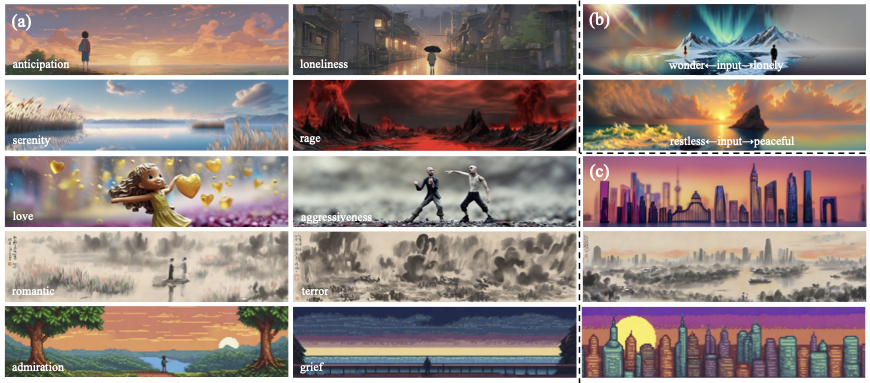
}Emotion is important for creating compelling virtual reality (VR) content. Although some generative methods have been applied to lower the barrier to creating emotionally rich content, they fail to capture the nuanced emotional semantics and the fine-grained control essential for immersive experiences. To address these limitations, we introduce EmoSpace, a novel framework for emotion-aware content generation that learns dynamic, interpretable emotion prototypes through vision-language alignment. We employ a hierarchical emotion representation with rich learnable prototypes that evolve during training, enabling fine-grained emotional control without requiring explicit emotion labels. We develop a controllable generation pipeline featuring multi-prototype guidance, temporal blending, and attention reweighting that supports diverse applications, including emotional image outpainting, stylized generation, and emotional panorama generation for VR environments. Our experiments demonstrate the superior performance of EmoSpace over existing methods in both qualitative and quantitative evaluations. Additionally, we present a comprehensive user study investigating how VR environments affect emotional perception compared to desktop settings. Our work facilitates immersive visual content generation with fine-grained emotion control and supports applications like therapy, education, storytelling, artistic creation, and cultural preservation. Code and models will be made publicly available.
EmoVid: A Multimodal Emotion Video Dataset for Emotion-Centric Video Understanding and Generation
AAAI 2026 (Oral)
@inproceedings{qiu2026emovid,
title={EmoVid: A Multimodal Emotion Video Dataset for Emotion-Centric Video Understanding and Generation},
author={Qiu, Zongyang and Wang, Bingyuan and Chen, Xingbei and He, Yingqing and Wang, Zeyu},
booktitle={Proceedings of the AAAI Conference on Artificial Intelligence},
volume={40},
number={10},
pages={8612--8620},
year={2026}
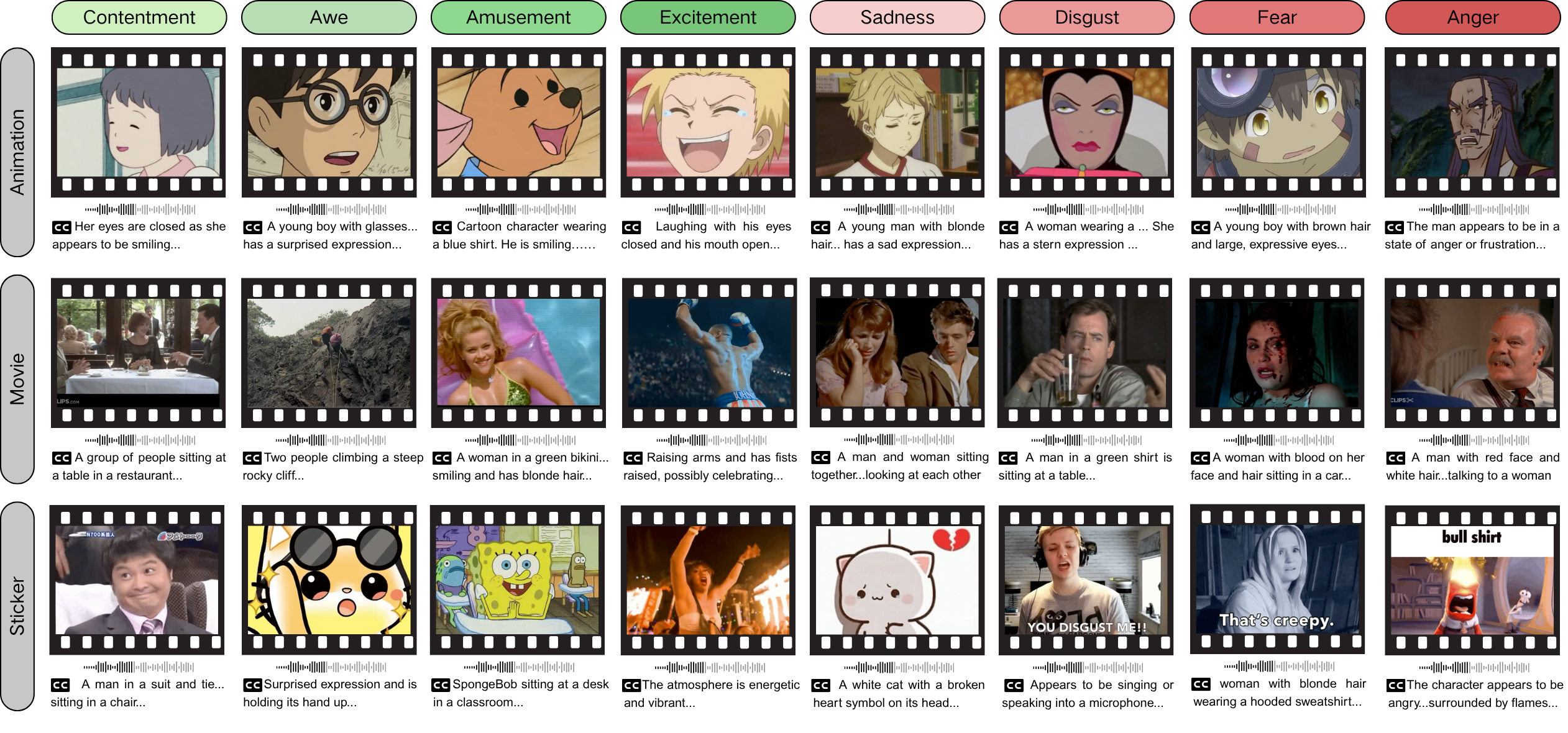
}Emotion plays a pivotal role in video-based expression, but existing video generation systems predominantly focus on low-level visual metrics while neglecting affective dimensions. Although emotion analysis has made progress in the visual domain, the video community lacks dedicated resources to bridge emotion understanding with generative tasks, particularly for stylized and non-realistic contexts. To address this gap, we introduce EmoVid, the first multimodal, emotion-annotated video dataset specifically designed for creative media, which includes cartoon animations, movie clips, and animated stickers. Each video is annotated with emotion labels, visual attributes (brightness, colorfulness, hue), and text captions. Through systematic analysis, we uncover spatial and temporal patterns linking visual features to emotional perceptions across diverse video forms. Building on these insights, we develop an emotion-conditioned video generation technique by fine-tuning the Wan2.1 model. The results show a significant improvement in both quantitative metrics and the visual quality of generated videos for text-to-video and image-to-video tasks. EmoVid establishes a new benchmark for affective video computing. Our work not only offers valuable insights into visual emotion analysis in artistically styled videos, but also provides practical methods for enhancing emotional expression in video generation.
Experience

Student Researcher

Research Assistant

Research Intern

Research Assistant
Education
The Hong Kong University of Science and Technology (Guangzhou)
MPhil in Artificial Intelligence
Advised by Prof. Hui Xiong (Fellow of ACM, IEEE, AAAI, AAAS, and CCF)
Research Topic: Multimodal Reasoning and Visual Generative AI

Fudan University (复旦大学)
B.S. in Computer Science · GPA 3.74/4.0
Coursework: Programming (A), Artificial Intelligence (Honors, A), Digital Image Processing (A), Set and Graph Theory (Honors, A)
Awards and Honors
Shanghai Outstanding Graduate (Top 5%)
National Scholarship (Top 1%, ranked 1st in the school)
Outstanding Student (Top 5%)
Meritorious Winner, Mathematical Contest in Modeling (Top 7%)
Gold Award, China International College Student Innovation Competition
Service
Reviewer
International Conference on Learning Representations (ICLR 2027)
AAAI Conference on Artificial Intelligence (AAAI 2026)
IEEE Transactions on Affective Computing
Let's Chat
I'm happy to chat about any academic topic, including ones well outside my own research. Pick a time below that works for you, or email me if none of the slots fit.
Calendar not showing? Open the booking page.